What comes to mind when you think of physiotherapy? It could be your pregnant friend seeking help with her back pain or your gym buddy recovering from a sprained ankle. Possibly, it’s the team physio running onto the pitch during a game to support an injured player.
Few people think of seeing a physiotherapist for jaw pain. You’re more likely to see your doctor or dentist initially. Yet physiotherapy plays a key role in the management of TMJ disorder, which is often influenced by muscle tension, joint dysfunction, and poor posture.
How can physiotherapy help manage TMJ pain?
Physiotherapists have an in-depth understanding of the musculoskeletal and nervous systems and their role in pain disorders.
That’s important because TMJ pain isn’t just in the jaw – it’s part of a broader pattern of tension that our physiotherapists are trained to address.
TMJ disorder involves key structures such as the:
- The temporomandibular joint itself
- Articular discs
- Major muscles such as the masseter, temporalis, medial and lateral pterygoids
- Supporting muscles like the digastric, mylohyoid and geniohyoid
- Associated muscles in the neck and upper back, such as the sternocleidomastoid, suboccipitals and trapezius.
At TMJ Clinics, our physiotherapists manage both the jaw and the interconnected systems that affect it, including the neck, shoulders, and posture.
How does physiotherapy for TMJ disorder work?
Physiotherapy treatment for TMJ disorder seeks to:
- Reduce jaw, neck and shoulder pain
- Improve jaw movement and alignment
- Relieve muscle tension caused by clenching or grinding
- Decrease the frequency and severity of headaches
- Help you break the cycle of muscle overuse and joint inflammation
- Help you adjust to wearing a night splint (if you’ve been prescribed one).
Typically, physiotherapy treatment involves a combination of:
- Hands-on treatment such as massage, joint mobilisation or dry needling, which is conducted during your appointment
- At-home exercises to help you retrain your habits.
Manual therapy: hands-on relief for jaw tension
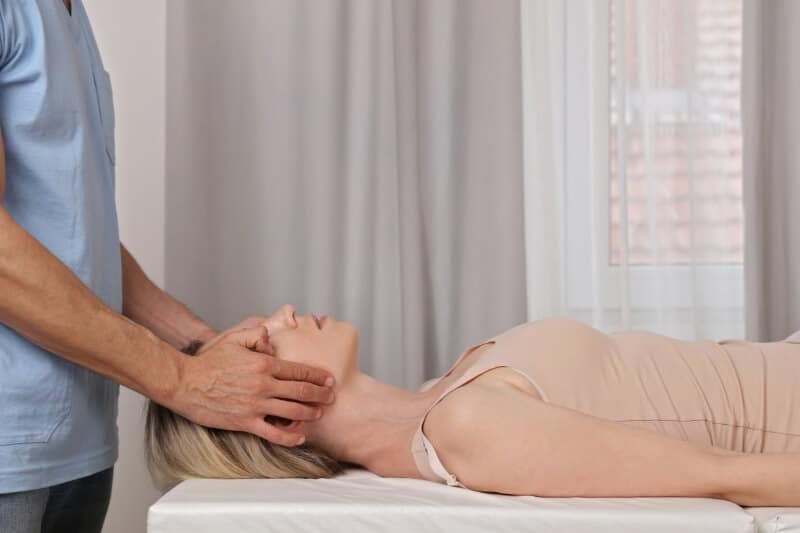
When treating the TMJ, physiotherapists may use hands-on techniques such as:
- Soft tissue massage to release tight jaw and neck muscles
- Joint mobilisation to improve jaw movement
- Myofascial release to reduce trigger points and referred pain
- Postural correction to realign the spine and reduce strain on the TMJ.
As well as loosening tight muscles, these treatments may help you feel more relaxed, especially if you’ve been living with chronic tension or stress-related clenching.
Physiotherapy exercises for TMJ: retrain your muscles
At-home physiotherapy exercises for TMJ help you keep up the momentum between sessions.
Your TMJ physiotherapist may guide you through:
- Jaw relaxation exercises to reduce muscle fatigue
- Controlled jaw opening and closing drills to improve range and alignment
- Tongue-to-palate positioning to stabilise the jaw
- Neck stretches and chin tucks to improve posture and decrease strain
- Strengthening exercises for the deep neck flexors and jaw-supporting muscles.
Each exercise is carefully selected based on your symptoms, lifestyle and treatment goals. Done consistently, these movements can help retrain the jaw and surrounding muscles, supporting long-term symptom relief.
And unlike online videos or generic advice, these exercises are tailored to your needs. Each person’s experience of TMJ disorder is unique and deserves more than a one-size-fits-all solution.
TMJ physiotherapy near me: find expert care close to home
At TMJ Clinics, our team understands the unique challenges of TMJ disorders and works collaboratively to deliver compassionate, evidence-based care.
All staff, including our physiotherapists, undergo our rigorous induction program, equipping them with the skills needed to manage TMJ disorder, working closely alongside dentists, psychologists and others involved in your care.
Disclaimer
All information is general and not intended as a substitute for professional advice.
References
- Australian Physiotherapy Association, What is physio? https://choose.physio/what-is-physio, [Accessed 11 June 2025]
- National Institute of Dental and Craniofacial Research, TMD, https://www.nidcr.nih.gov/health-info/tmd#treatment, [Accessed 11 June 2025]